Contact: helpdesk@swadeshsiksha.com
Register Admission Fee Payment
Description of the image
Certificate in Data Science with Generative AI | Course Details

Certificate in Data Science with Generative AI

Online Courses Online 6 months
Certificate in Data Science with Generative AI
Rs. 25,000
Total Course Fee (including all taxes)

Course Overview

Course Code
CRS0004
Status
Active
Duration
6 months
Class Schedule

Description

Description

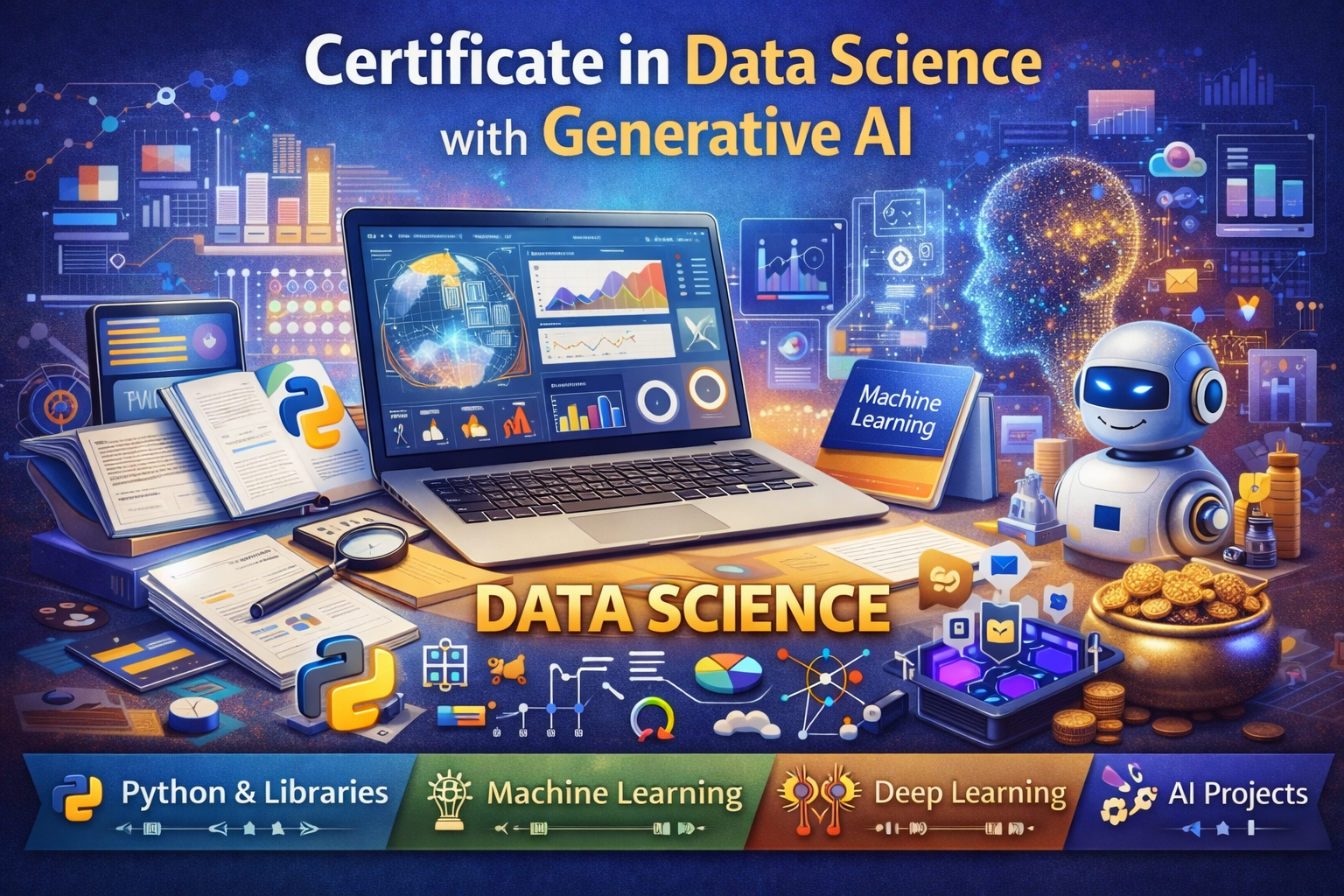
The Certificate in Data Science with Generative AI is a comprehensive six-month program designed to equip learners with strong data analytics expertise, machine learning skills, and practical knowledge of Generative AI technologies. This course combines core data science principles with hands-on programming, real-world project experience, and AI-driven innovation tools, preparing students for careers in data analytics, artificial intelligence, machine learning, and business intelligence domains.

Ideal for students, aspiring data professionals, engineers, IT enthusiasts, and working professionals, this program enhances analytical thinking, technical proficiency, and problem-solving abilities while introducing cutting-edge Generative AI tools that are transforming modern data-driven industries.


Course Overview

The program provides hands-on training in:

• Data science fundamentals and statistical analysis
• Python programming for data analysis
• Data cleaning, transformation, and exploratory data analysis (EDA)
• Data visualization and business intelligence reporting
• Supervised and unsupervised machine learning techniques
• Deep learning fundamentals and neural networks
• Generative AI concepts and Large Language Models (LLMs)
• Prompt engineering and AI application development
• Model deployment and MLOps basics
• Capstone project development and employability skills

This integrated approach ensures learners gain both strong analytical foundations and practical AI implementation skills required for professional growth in data-driven organizations.


Key Learning Outcomes

By the end of this course, learners will be able to:

• Analyze and interpret structured and unstructured data
• Write Python programs for data analysis and modeling
• Perform data cleaning and exploratory data analysis
• Create dashboards and visual reports for business insights
• Build and evaluate machine learning models
• Apply deep learning concepts to solve real-world problems
• Develop Generative AI applications using Large Language Models
• Deploy machine learning models into production environments
• Build a professional data science portfolio for career opportunities


Core Modules

• Introduction to Data Science & Statistics
• Python Programming for Data Science
• Data Cleaning & Exploratory Data Analysis
• Data Visualization & Business Intelligence
• Supervised & Unsupervised Machine Learning
• Deep Learning Foundations
• Generative AI & Large Language Models
• Prompt Engineering & AI Applications
• Model Deployment & MLOps Basics
• Industry Capstone Project
• Employability Skills & Career Development


Duration

6 months (may vary depending on institution and academic schedule)


Eligibility

• Open to students from any educational background (Science/Engineering/IT preferred)
• Basic mathematics knowledge recommended
• No prior programming experience required (foundational training included)


Career Opportunities

After completing the Certificate in Data Science with Generative AI, candidates can pursue roles such as:

• Data Analyst
• Junior Data Scientist
• Machine Learning Engineer
• AI Developer
• Business Intelligence Analyst
• NLP Engineer
• Generative AI Specialist
• Data Science Consultant

This certification enhances employability, builds a strong foundation in data analytics and artificial intelligence, and prepares learners for professional opportunities in technology companies, startups, research organizations, consulting firms, and data-driven enterprises.

Curriculum

Month 1: Programming & Data Science Foundations

Module 1: Introduction to Data Science & Analytics

Module Description:
Builds strong foundational knowledge in data science concepts, analytics lifecycle, and industry applications.

• What is Data Science? Scope and career opportunities
• Data Science lifecycle (collection, cleaning, analysis, modeling, deployment)
• Types of data: structured vs unstructured
• Introduction to statistics for data science
• Mean, median, variance, standard deviation
• Probability fundamentals
• Business problem understanding & data-driven decision making
• Overview of tools used in Data Science


Module 2: Python Programming for Data Science

Module Description:
Equips learners with programming skills required for data analysis and machine learning.

• Introduction to Python
• Variables, data types, operators
• Control structures (if-else, loops)
• Functions & modules
• Lists, tuples, dictionaries, sets
• File handling
• Exception handling
• Introduction to Jupyter Notebook
• Working with NumPy & Pandas libraries

Practical:
Mini project – Data analysis using Python and Pandas


Month 2: Data Analysis & Visualization

Module 3: Data Cleaning & Exploratory Data Analysis (EDA)

Module Description:
Develops practical skills in preparing and analyzing datasets.

• Data importing & exporting
• Handling missing values
• Data transformation & normalization
• Feature engineering basics
• Outlier detection
• Correlation analysis
• Exploratory Data Analysis techniques
• Working with real-world datasets


Module 4: Data Visualization & Business Reporting

Module Description:
Focuses on creating meaningful visual insights for business decision-making.

• Data visualization principles
• Using Matplotlib & Seaborn
• Interactive dashboards using Power BI / Tableau basics
• Creating charts, graphs, and dashboards
• Business storytelling with data
• Reporting insights effectively

Practical:
Build interactive dashboard & EDA report


Month 3: Machine Learning Fundamentals

Module 5: Supervised Machine Learning

Module Description:
Introduces core predictive modeling techniques used in industry.

• Introduction to Machine Learning
• Regression (Linear & Multiple)
• Logistic Regression
• Decision Trees
• Random Forest
• Model evaluation (Accuracy, Precision, Recall, F1 Score)
• Train-test split & cross-validation


Module 6: Unsupervised Learning & Model Optimization

Module Description:
Focuses on pattern detection and improving model performance.

• Clustering (K-Means, Hierarchical)
• Dimensionality reduction (PCA basics)
• Feature selection
• Hyperparameter tuning
• Model optimization techniques
• Introduction to Scikit-Learn

Practical:
Predictive modeling project with performance evaluation


Month 4: Deep Learning & Generative AI

Module 7: Deep Learning Foundations

Module Description:
Provides understanding of neural networks and deep learning concepts.

• Introduction to Neural Networks
• Activation functions
• Backpropagation concept
• Introduction to TensorFlow / PyTorch
• Building basic neural networks
• Overfitting & regularization


Module 8: Generative AI & Large Language Models

Module Description:
Introduces cutting-edge Generative AI technologies and practical applications.

• What is Generative AI?
• Overview of Large Language Models (LLMs)
• Introduction to ChatGPT and prompt engineering
• Text generation & summarization
• Image generation tools overview
• Retrieval-Augmented Generation (RAG) basics
• Ethical AI & responsible AI practices
• Applications of Generative AI in business

Practical:
Build AI-powered content generation or chatbot prototype


Month 5: Advanced Data Science & Deployment

Module 9: Advanced Topics in Data Science

Module Description:
Enhances technical capabilities for real-world data projects.

• Time series analysis basics
• Recommendation systems overview
• Natural Language Processing (NLP) basics
• Sentiment analysis
• Working with APIs
• Data scraping basics


Module 10: Model Deployment & MLOps Basics

Module Description:
Prepares learners for production-level implementation.

• Model deployment concepts
• Introduction to Flask / FastAPI
• Cloud deployment basics
• Version control using Git
• CI/CD overview
• Monitoring & maintaining ML models

Practical:
Deploy a machine learning model as a web application


Month 6: Capstone Project & Career Development

Module 11: Industry Capstone Project

Module Description:
End-to-end data science project integrating analytics and Generative AI.

• Problem identification
• Data collection & cleaning
• Model development
• AI integration (LLM or generative tool)
• Dashboard creation
• Model deployment
• Final presentation & documentation


Module 12: Employability Skills & Career Preparation

Module Description:
Prepares learners for job placement and freelance opportunities.

• Resume building for Data Science roles
• GitHub portfolio creation
• LinkedIn profile optimization
• Interview preparation (technical + HR)
• Case study solving
• Freelancing & consulting opportunities
• Career paths: Data Analyst, Data Scientist, ML Engineer, AI Specialist

Final Practical:
Capstone project presentation & Viva


Assessment

• Monthly practical assignments
• Machine learning model evaluation test
• Generative AI project submission
• Final capstone project
• Viva voce examination


Outcome

After completing this course, learners will be able to:

• Perform data analysis using Python
• Build machine learning models
• Apply deep learning techniques
• Develop Generative AI-based solutions
• Deploy ML models to production
• Create dashboards and business insights
• Build a professional data science portfolio


Career Opportunities

• Data Analyst
• Junior Data Scientist
• Machine Learning Engineer
• AI Developer
• Business Intelligence Analyst
• NLP Engineer
• Generative AI Specialist
• Data Science Consultant

Request a Free Demo Class

Experience the course before you enroll. Fill the form and our expert will contact you within 24 hours.

Back to Courses